
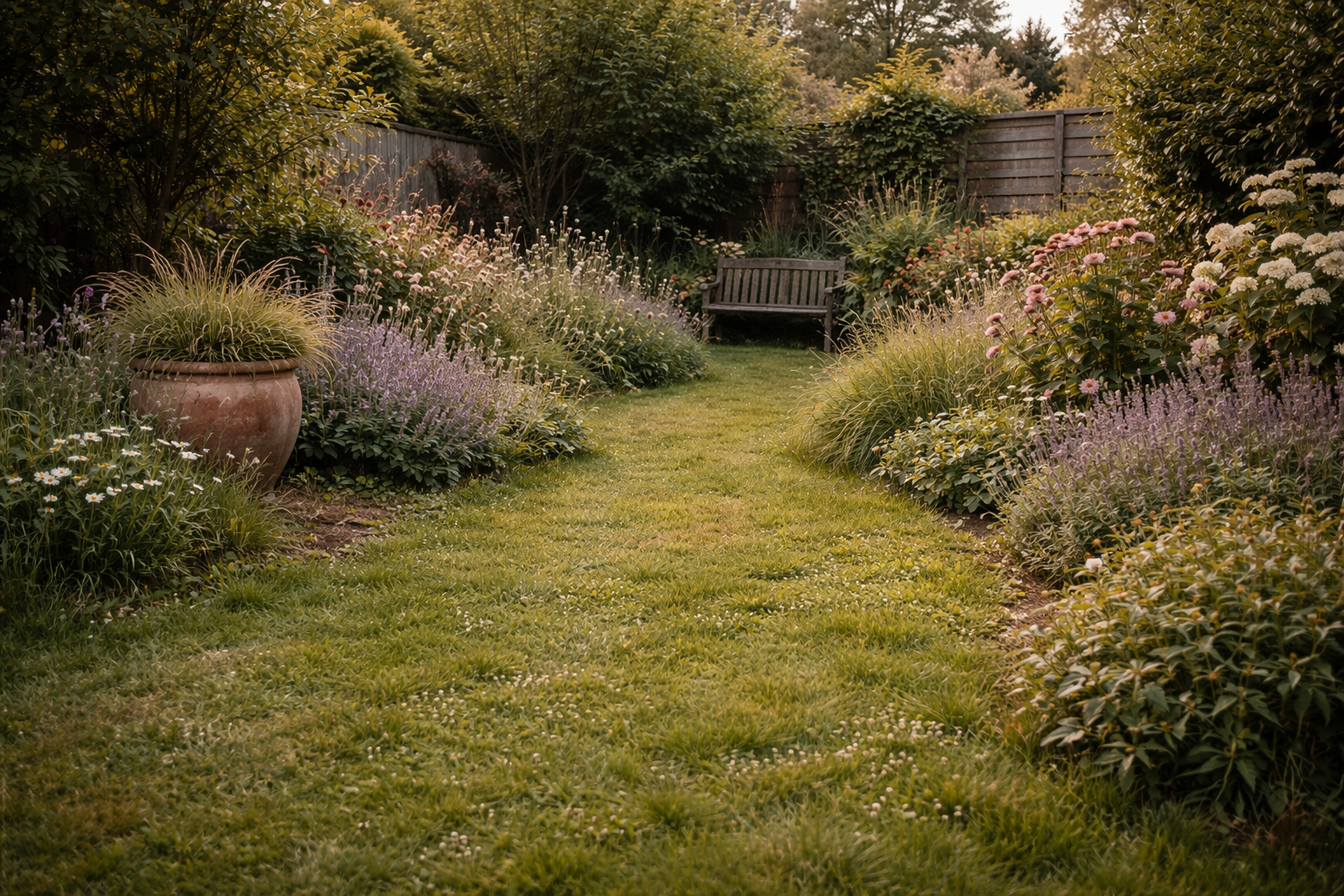
The Quiet Structure of the English Garden
A garden is often thought of as something that simply grows — shaped by season and soil, responding quietly to light and weather. Yet the gardens that feel most effortless are rarely accidental.
Left to itself, a garden will find its own rhythm. And while there is truth in this, it is only part of the picture.
The gardens that feel most natural are often those that are most carefully considered.
They are held together by something less obvious — a quiet framework that sits beneath the surface, guiding rather than controlling, allowing the garden to move without ever feeling untethered.
A Framework Beneath the Surface

Structure in a garden is often subtle.
A path that draws the eye without insisting upon it. An edge that defines space without feeling rigid. A support that lifts a plant just enough to give it presence.
These elements are not designed to stand out. In fact, when they are most successful, they are barely noticed at all.
And yet, without them, something feels unresolved.
It is easy to confuse structure with formality.
But the two are not the same.
Structure is not about strict lines or symmetry. It is not about imposing order for its own sake. Rather, it is about providing a sense of balance — a quiet discipline that allows looser planting to feel intentional rather than accidental.
In this sense, structure in a garden is not about control, but about creating a framework within which planting can flourish.
A garden can be generous, even slightly untamed, and still feel composed.
Often, it is the presence of a few well-placed elements — a line held, a form repeated, a vertical moment introduced — that creates this sense of calm.
The Role of Vertical Structure

Vertical structure plays a particular role.
In early spring, before borders have filled out, these elements come into their own. An obelisk, a simple frame, or a climbing support offers height and rhythm, drawing the eye upward and giving the garden a sense of proportion.
Later, as growth takes hold, these same structures recede — no longer the focus, but still quietly doing their work.
They do not compete with the planting. They support it.
Materials That Belong
Materials, too, are part of this framework.
Wood that softens and silvers over time. Iron that deepens with exposure to the elements. Clay that settles into its surroundings, gradually losing any sense of newness.
These are not materials that resist the garden, but ones that become part of it.
They do not demand attention. They absorb it.
And in doing so, they reinforce the sense that the garden has evolved rather than been assembled.
A Sense of Restraint
Perhaps this is what defines a well-considered garden.
Not the absence of structure, but its restraint.
Nothing forced. Nothing overstated.
Just enough guidance to allow everything else to fall into place.
In the end, a garden is neither entirely designed nor entirely wild.
It is shaped.
Gently, over time — through decisions that are often small, but rarely insignificant.
And beneath it all, holding everything together, is a structure that is felt far more than it is ever seen.

Written by Simon Stevens



Leave a comment
This site is protected by hCaptcha and the hCaptcha Privacy Policy and Terms of Service apply.