
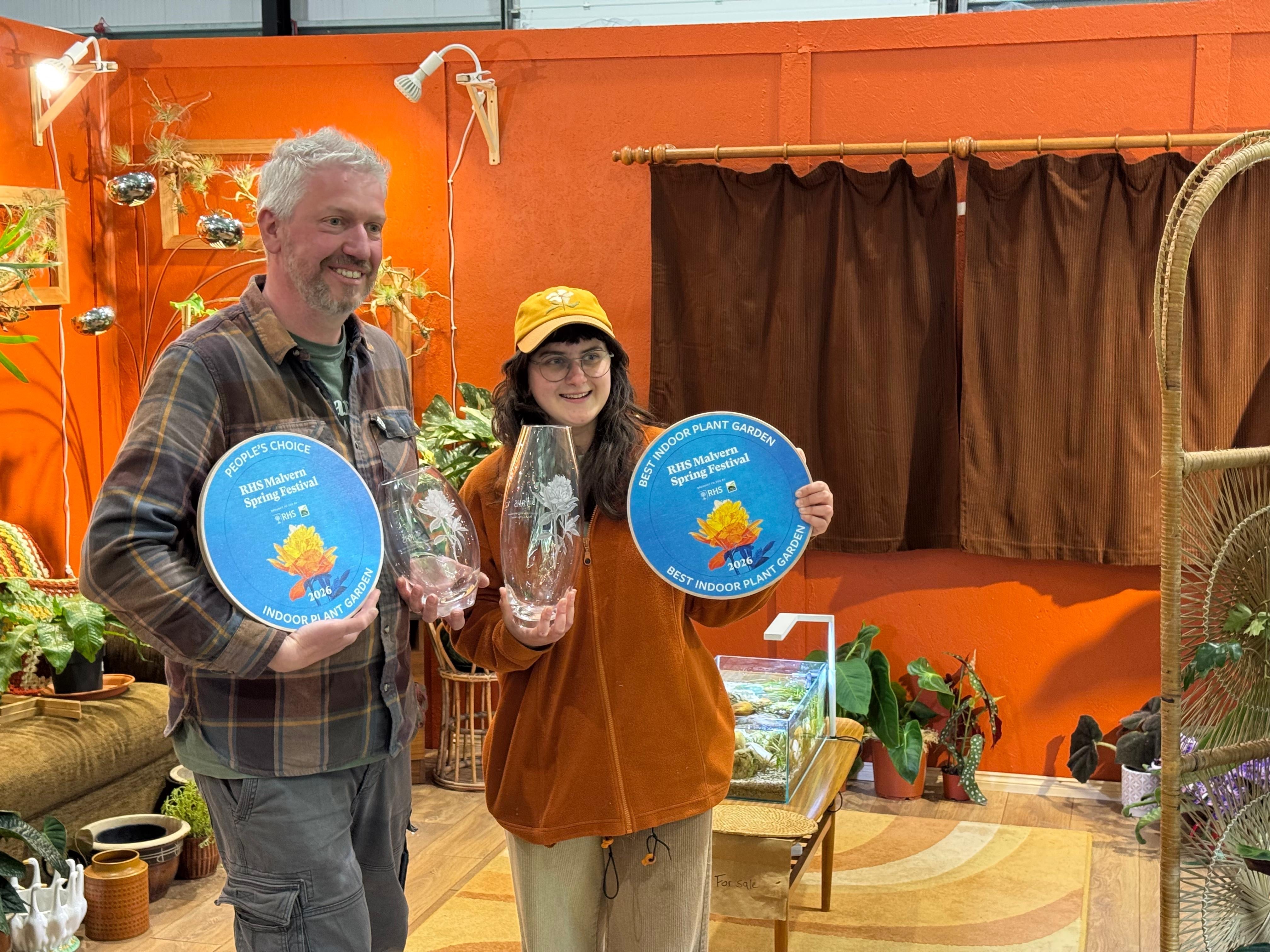
Back to Grandma's House: The Story Behind Alina Hibbert's Gold Medal Garden
There is a particular kind of gardener who doesn't simply tend plants, they form a relationship with them. Alina Hibbert is that kind of gardener. At 28, she has just taken gold at RHS Malvern Spring Festival for her indoor show garden Back to Grandma's House, a warmly conceived 1970s-inspired space built around house plants, terrarium displays, and the quietly radical idea that the plants we surround ourselves with can make us feel safe.
It is a philosophy rooted not in theory but in lived experience.

Roots
Alina grew up in Sherborne, Dorset, the daughter of a man who has gardened since he was sixteen. From the age of seven, she knew she wanted to be a garden designer. She remembers sitting in a school computer room, reading about the profession, and deciding immediately that she wanted to do both the designing and the physical work. The idea of a designer who didn't get their hands dirty struck her as entirely missing the point.
Her first job, at fifteen, was at Castle Gardens in Sherborne, a Sunday position in the house plant section. Rather than simply watering and tidying, she made a practice of selecting one plant each week from the encyclopaedia kept behind the counter, reading everything about it, and testing herself on what she had retained by the end of the day. It was self-directed learning of the most practical kind, and it laid a foundation that has never left her.

It was here that she encountered a piece of advice she still keeps close. A colleague told her that if a maidenhair fern ever dries out and crisps, the remedy is simple: cut it back hard, "to a hedgehog," as she puts it, give it good light, keep the watering consistent, and it will grow back. She has used that method ever since. It sounds like a small thing. For Alina, it is an example of the kind of quietly passed-on knowledge that defines real horticultural craft.
A Difficult Chapter, and What Grew From It
After her time at Castle Gardens, Alina went on to work at a garden centre whilst studying, deepening her knowledge of outdoor plants and finding a mentor in the head of the garden department, someone she describes with obvious warmth as a person you could spend hours talking to about roses.
Then came a difficult period. A relationship ended badly. She found herself in Wales, far from family, without a garden, and going through what she describes honestly as a very hard time, depression, anxiety, isolation. The outdoor growing space she had come to rely on was gone.
What saved her, in part, was a small house plant shop that opened nearby. She walked in and asked if she could volunteer, simply because she missed being around plants. The owner, only a few months into running the business himself, said yes. That decision changed the direction of her life.
Working one day a week, unpaid, and happy that way, she began rebuilding her connection to greenery, filling her university halls with plants, learning everything she could. When the shop grew and moved into a café and restaurant space, she was still there. She carried on volunteering even after finding paid work elsewhere, because she genuinely didn't want to leave.
The plants she collected during that period are still with her. A pilea peperomioides, the Chinese money plant, taken as a cutting from her garden centre days, is now nine years old and travels with her everywhere she goes.
A Woman and Her Ferns

Ask Alina about ferns and she will talk at length, and with evident pleasure. Her bathroom is currently home to at least seven varieties: maidenhair, bird's nest, blue star, crocodile, kangaroo paw, and staghorn among them. The staghorns, platycerium, to give them their proper name, are a particular passion. In the wild they grow epiphytically on trees; at home, Alina mounts hers on walls, where they spread in the manner nature intended. She finds them endlessly compelling.
The maidenhair holds a special place. It is, she acknowledges, the trickier end of the indoor fern spectrum, the daintier the leaf, generally speaking, the more demanding the plant. But she has learned its ways, and the hedgehog method has rescued more than one from an untimely end.
She also tends an allotment, which she had visited that very morning before we met, a detail that speaks to the breadth of her relationship with plants. Indoor and outdoor, cultivated and wild, designed and grown: for Alina, it is all part of the same conversation.
The Gold
The idea for Back to Grandma's House came from Alina's long love of 1970s interiors, the colours, the furniture, the warmth. She had submitted a version of the concept the previous year under a different name and not been accepted, but the RHS encouraged her to try again. This time she partnered with a friend, Adam Critien, whose practical grounding complemented her creative vision. Together they developed the design, rendered it digitally in isometric form with the help of a friend who works in illustration, and submitted it under a name that arrived almost by accident. The garden was made possible with the generous support of sponsor Jeffrey Ross.
They were discussing how they wanted the garden to feel, warm, safe, inviting, and Adam said it was going to be like going back to your grandma's house. The name stuck immediately.
The garden featured a bold statement wall, a collection of carefully chosen house plants, and a series of terrariums and display cases, including a cabinet Alina built herself specifically for the show. The aesthetic was deliberate: a space that felt lived-in and loved rather than designed for spectacle.

When the judges awarded gold, Alina wept. There are photographs. There is video. She is not embarrassed about any of it.
"It was so validating," she says. For someone who had spent years navigating self-doubt and the persistent dismissal that younger women in horticulture will recognise all too well, she recalls a customer at the garden centre taking one look at her and saying she wouldn't know anything, the gold felt like more than a horticultural award. It felt like proof.

A Diagnosis, and What It Explained
Part of what makes Alina's story particularly resonant right now is that she received an ADHD diagnosis only last month. Late diagnosis is common for women, who are often more adept at masking the signs. For Alina, the diagnosis reframed a great deal, the difficulty regulating energy, the relentless internal dialogue that swings between fierce self-belief and crushing self-criticism, the fatigue that has been a persistent companion. She is awaiting medication and, she says, quietly excited about it, not least because of what she has heard from friends whose lives have shifted meaningfully once the right dosage was found.
The diagnosis did not change who she is. But it gave her language for it, and a clearer understanding of why she has always gravitated naturally towards people on a similar frequency, and why, when she simply allows herself to be herself rather than a managed, polished version of herself, people respond so strongly.
Her appearance on Gardeners' World following the show demonstrated that clearly. The weekend after the episode aired, she says, everyone who came to the show garden had seen her on television. The response was unanimous: she was natural, warm, entirely herself. People wanted more.
What Comes Next
Alina is thoughtful about the future, and deliberately so. She speaks of wanting to do more RHS shows, to inspire people about plants, indoors and out, and to explore plant-led design more broadly. She is drawn to a practice that doesn't distinguish rigidly between garden design and interior planting, but treats plants as a design medium in any space. She has a YouTube channel, a growing Instagram following, and has recently been invited to appear on a gardening podcast.
A horticultural degree has always been at the back of her mind. It is still there. At college, she says, the choice was between art and horticulture. Her father, a lifelong gardener himself, told her to do art. She has always known she would return to horticulture eventually.
She tends her allotment, keeps her growing collection of ferns and house plants, and has a cherry tree whose story she carries with her. The show being over means she can now focus on displaying her plants properly at home, decorating her space, and planning what comes next.
She is 28. She has just won gold at one of the country's most respected horticultural festivals. The inner seven-year-old who wanted to be a garden designer, it seems, was right all along.
A note from English Country Gardens
We are hoping to welcome Alina as a guest on the English Country Gardens podcast later this year, where we will speak with her in more depth about her journey, her approach to plant design, and what she hopes to build next. Watch this space.

Follow Alina on Instagram: @littleplantlover
Back to Grandma's House was exhibited at RHS Malvern Spring Festival 2026.

Leave a comment
This site is protected by hCaptcha and the hCaptcha Privacy Policy and Terms of Service apply.